
Iron Auditor
A gym log that gets out of your way.
Start a session, pick exercises, log your sets — reps, weight, done. No sign-up, no cloud, no distractions. Your data stays on your device.

 LIVE · iOS + ANDROID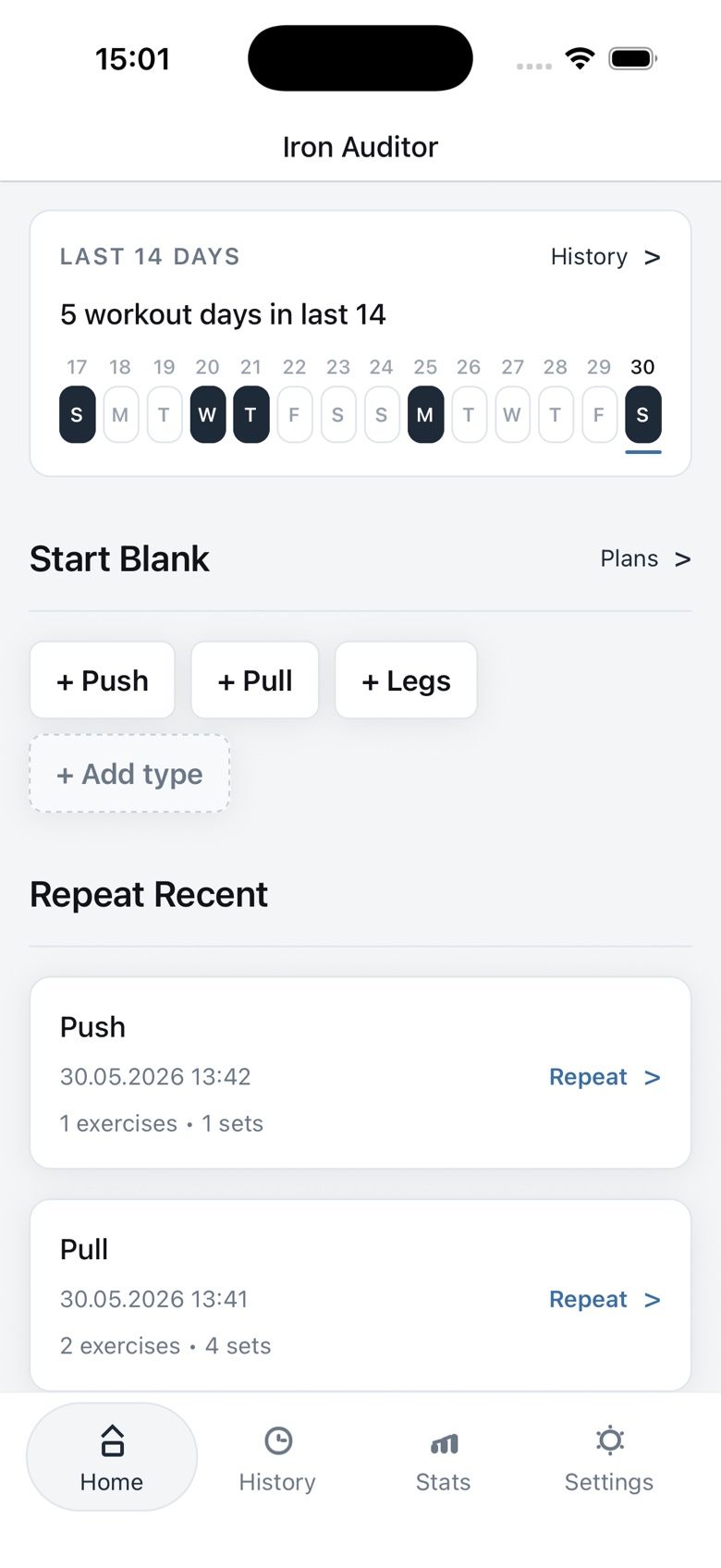
What it does
Tap through sets with minimal effort.
Quick-step buttons for reps and weight (+1 rep, +2.5 kg), mark each set done or skipped, rest timer running at the bottom. The app remembers your last workout so you can repeat it or build on it.
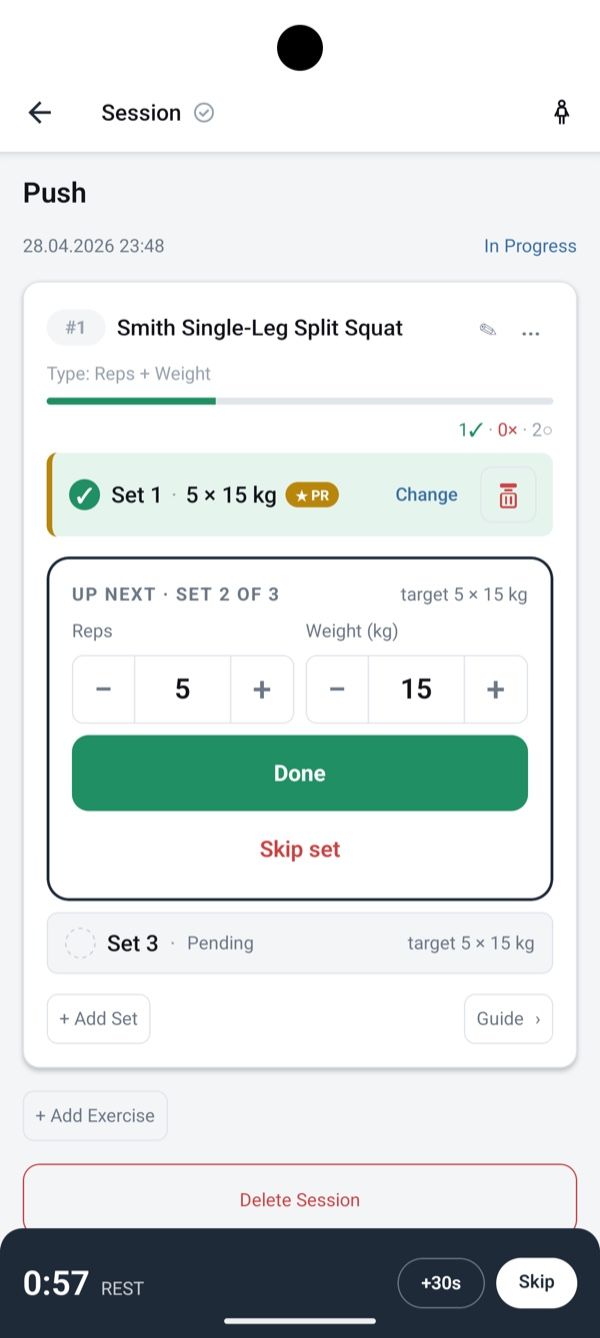
Search, filter by equipment, or browse a body map.
Filter by muscle group or equipment, or open the body map to pick visually. Every built-in exercise carries its muscle targets; add your own custom exercises in seconds.
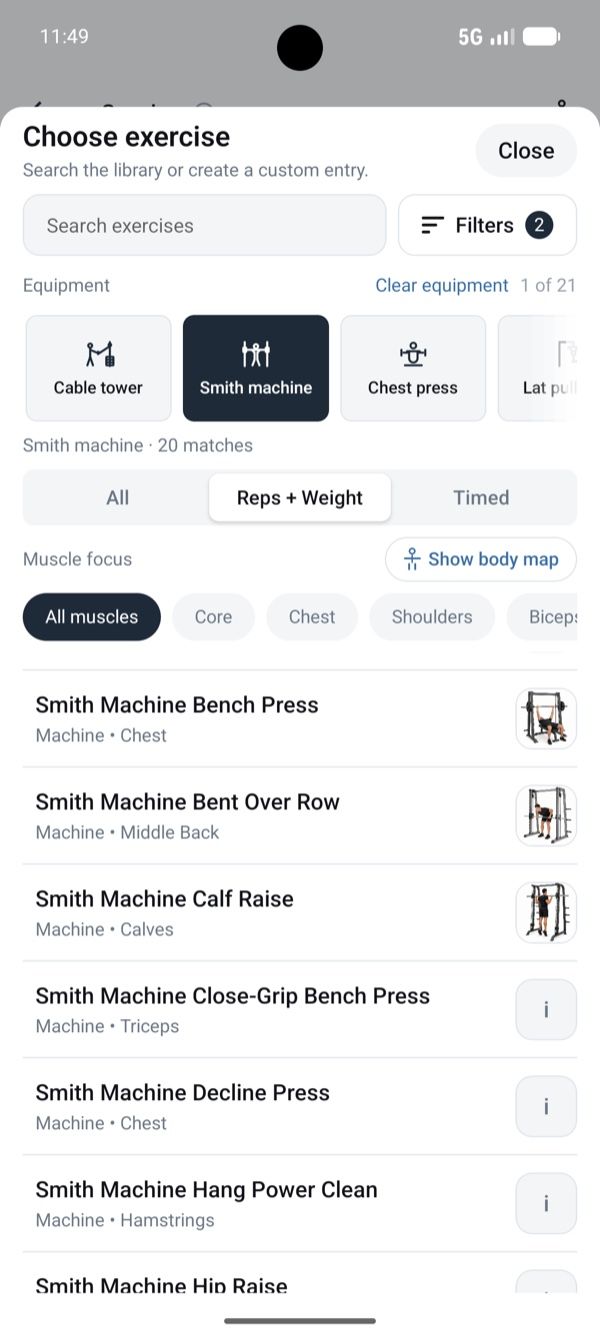
A guide for every exercise.
Each exercise has an illustrated guide and a primary / secondary muscle map, so you can confirm you’ve picked the right movement before you start the set.
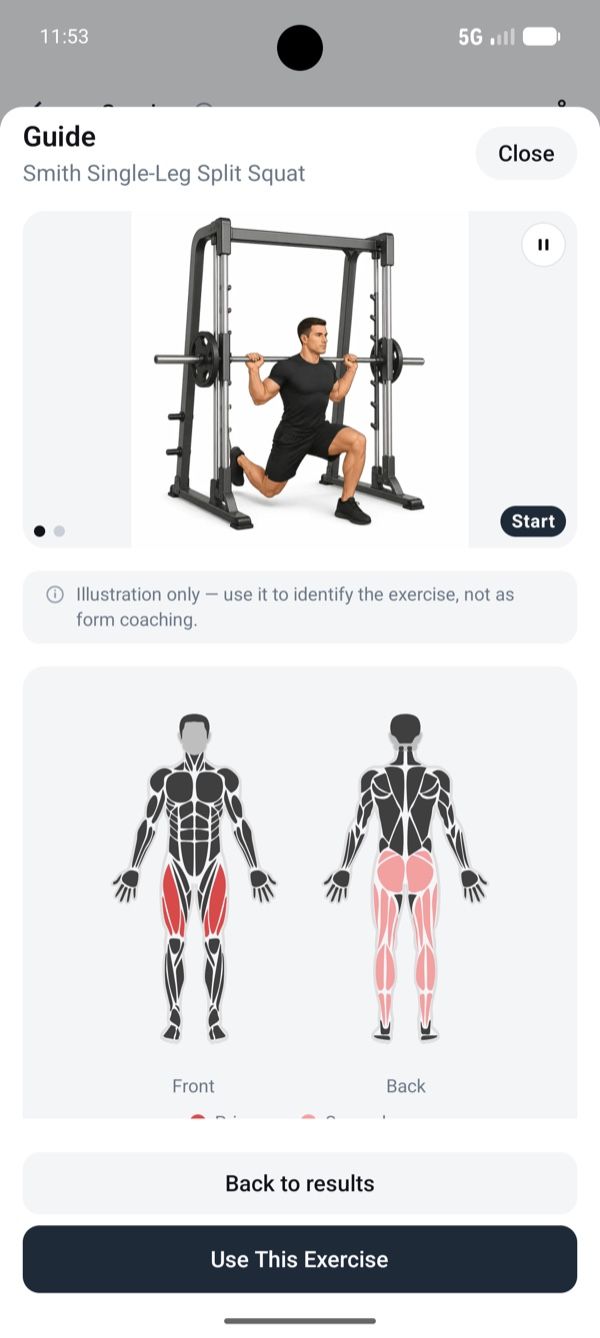
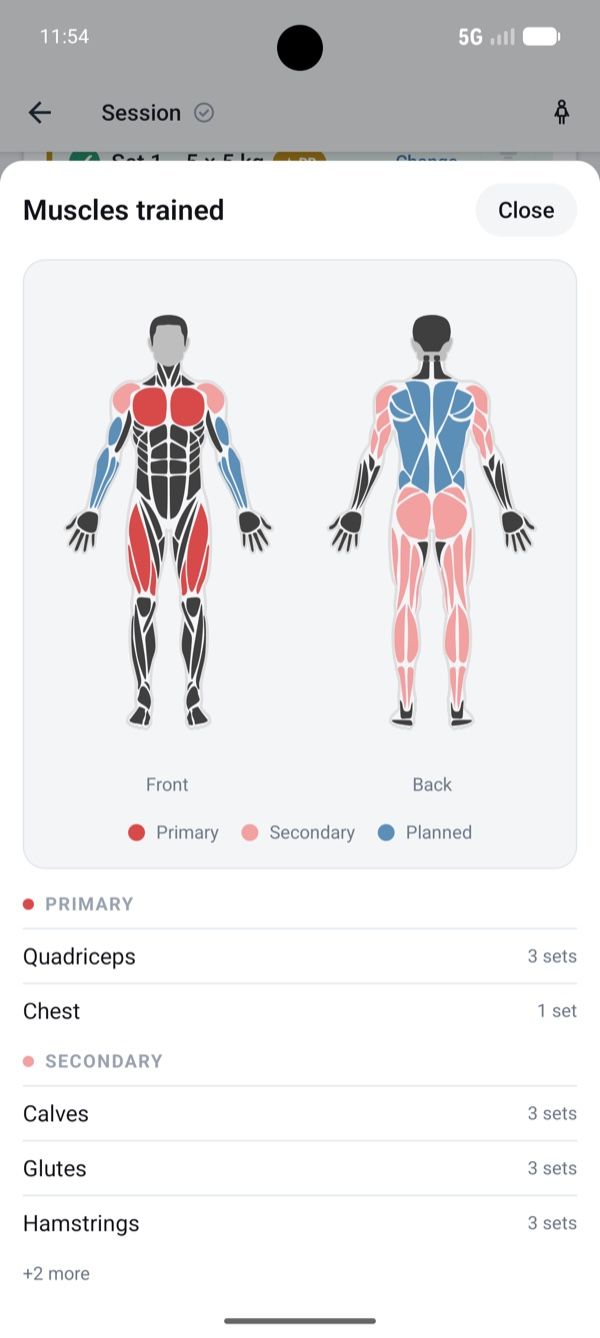
Front and back muscle maps after every session.
Primary, secondary, and planned muscles shaded on anatomical figures, with a per-muscle set breakdown — so you can see your coverage and balance at a glance.
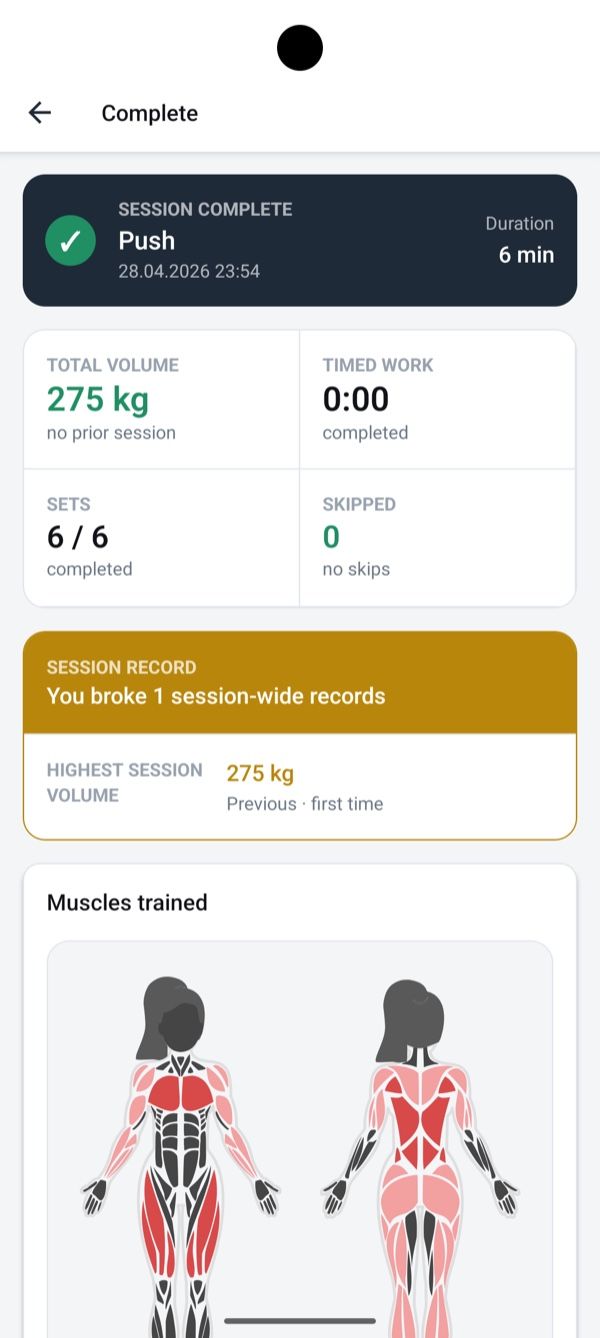
Volume, set completion, and automatic PRs.
Each session closes with total volume, sets completed, time, and any records broken. Personal records — weight, reps, volume — are tracked automatically.
Your data never leaves your phone.
All data is stored on your device. No account required. No tracking. No ads. Export everything as JSON whenever you want.
The only data that ever leaves your phone is anonymous crash diagnostics — and you can read exactly what that means in the privacy policy.
Privacy policy →Also a working experiment in agentic software engineering.
What one engineer can ship with current AI tooling when the process is built around verification rather than vibes.
Most of what the agents do isn’t writing code — it’s reading context.
The system is governed by a workflow contract that’s re-read before every change. Specification, test plan, and architectural decisions are the product’s memory; code is just the current expression of them.
Four sources of truth, re-read before any change.
- ~2,300line specification of product behaviour
- ~1,100line test plan with 401 numbered scenarios
- 17architectural decision records
- 1workflow contract defining the rules of engagement
Change as little as possible. Keep documentation, tests, and code in agreement.
Pure helpers first, strict typed transitions, screens composed from tested pieces.
Lint, strict TypeScript, and a 401-scenario test suite where every test row cites a numbered scenario ID. A local “shadow CI” enforces advisory rules including citation coverage.
A pre-commit hook blocks only the failures a later commit can’t fix. Every change is traceable from scenario to test to commit.
Explicit risks called out, assumptions documented, untested areas reported.
Disagreements between the agent and the rules become artifacts, not silent drift.
The interesting constraint isn’t getting an AI to write code — it’s getting a system where the AI spends more time re-reading context than emitting code, so that what ships is traceable and verifiable. That’s the part that transfers to client work.
Iron Auditor is the public reference for how I approach AI-assisted delivery: specification first, verification throughout, traceability end to end. The same method — adapted to a client’s codebase, review culture, and constraints — is part of how I work on delivery engagements.
Download Iron Auditor
Free on iOS or Android. Local-first, private by design, 731 exercises built in.
See how the method applies
The verification-first process behind Iron Auditor — adapted to delivery and systems work.