Hi-fi tower loudspeaker — prototype 2
ScanSpeak Illuminator + Revelator, 35-litre ported floorstander. A clean, low-distortion two-way built around a pair of ScanSpeak's reference drivers, with a fourth-order Linkwitz-Riley crossover specified so the network itself isn't the limit.
The brief was straightforward: pick two drivers known for low distortion and good off-axis behaviour, put them in a properly-tuned cabinet, and design a passive crossover with parts good enough that the crossover stops being a variable in how the speaker measures and sounds.
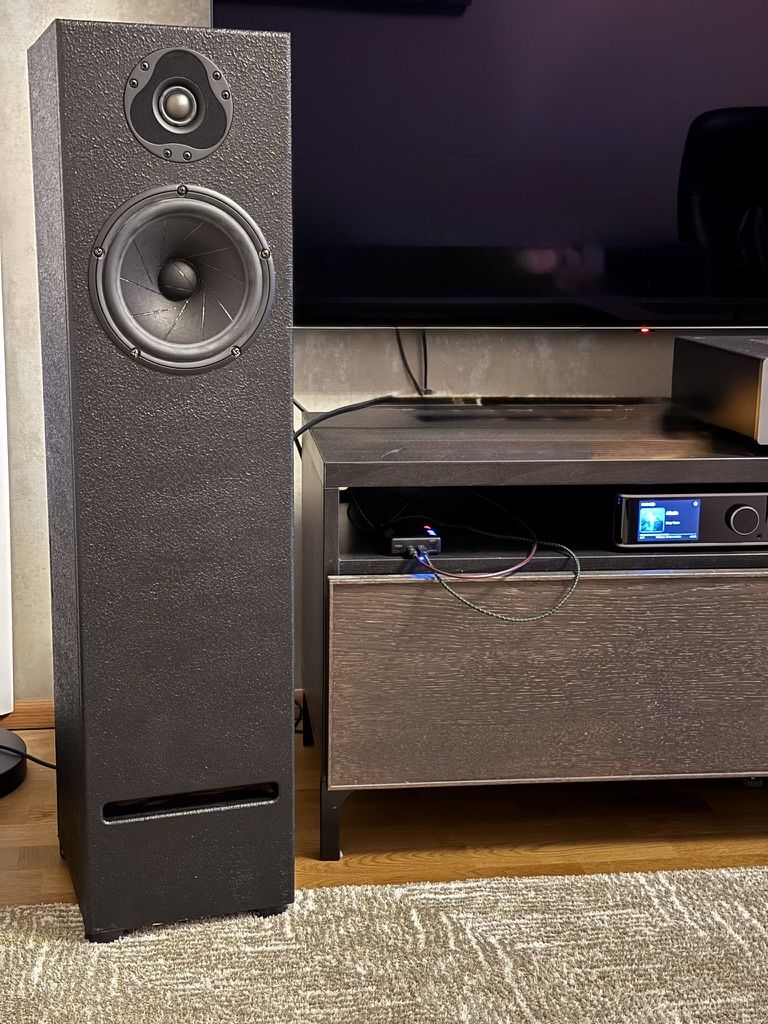
Drivers
Tweeter — ScanSpeak Illuminator D3004/6620-00. 26 mm coated fabric dome with the ring-magnet motor. Low distortion, smooth top end, notably uncoloured.
Woofer — ScanSpeak Revelator 18W/4531G00. 6.5-inch sliced paper cone with the symmetric drive motor. The 4-ohm version.
Cabinet
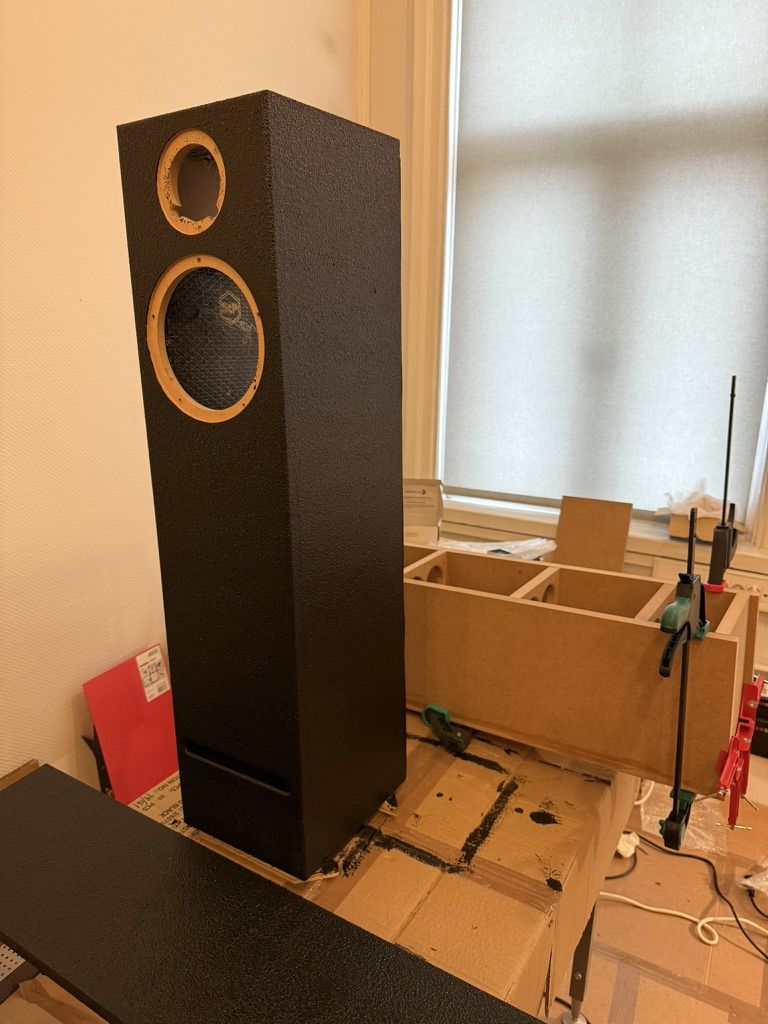
- Form factor
- Floorstanding tower
- External dimensions
- ~900 × 221 × 268 mm (H × W × D)
- Wall material
- 19 mm
- Net internal volume
- 35 litres
- Front-firing slot port
- 183 × 19 mm aperture, 180 mm length
- Bracing
- Cross-braced; port-chamber section to be tightened
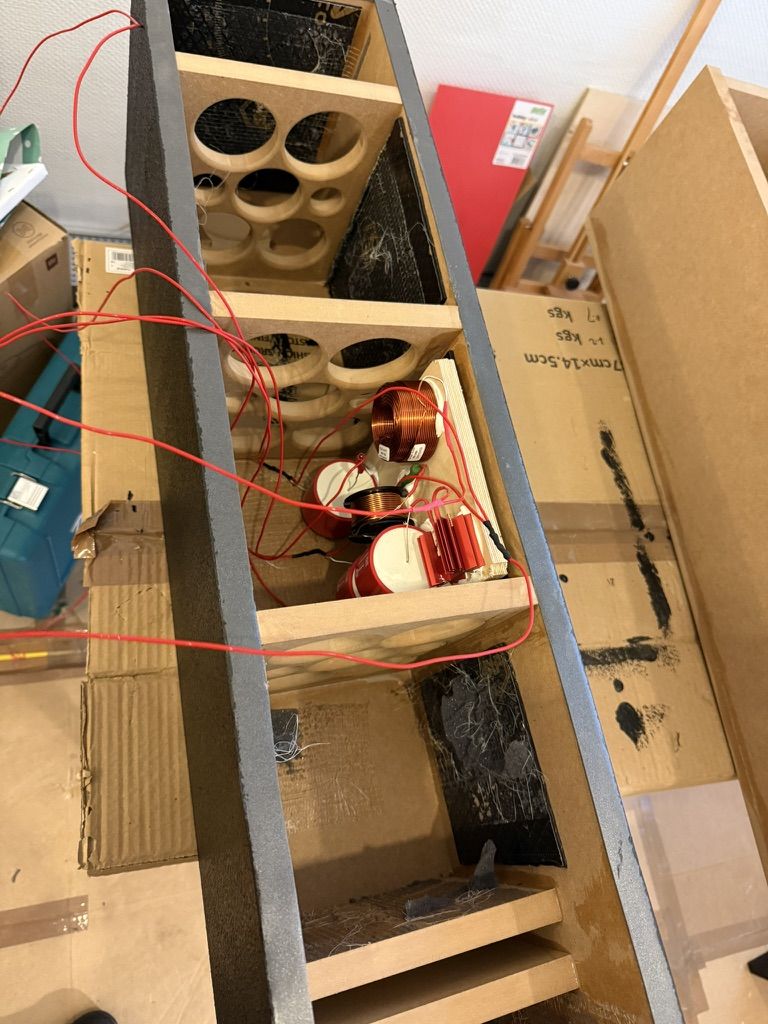
Crossover
- Topology
- LR4 high-pass on tweeter; LR2 low-pass on woofer
- HP capacitors
- ClarityCap CMR 10 µF + 8.2 µF (400 Vdc, ±3 %)
- LP capacitor
- ClarityCap CMR 16 µF (400 Vdc, ±3 %)
- Inductors
- Air-core throughout
- Tweeter series R
- 5.6 Ω wirewound, heatsinked
- HP damping R
- 150 mΩ
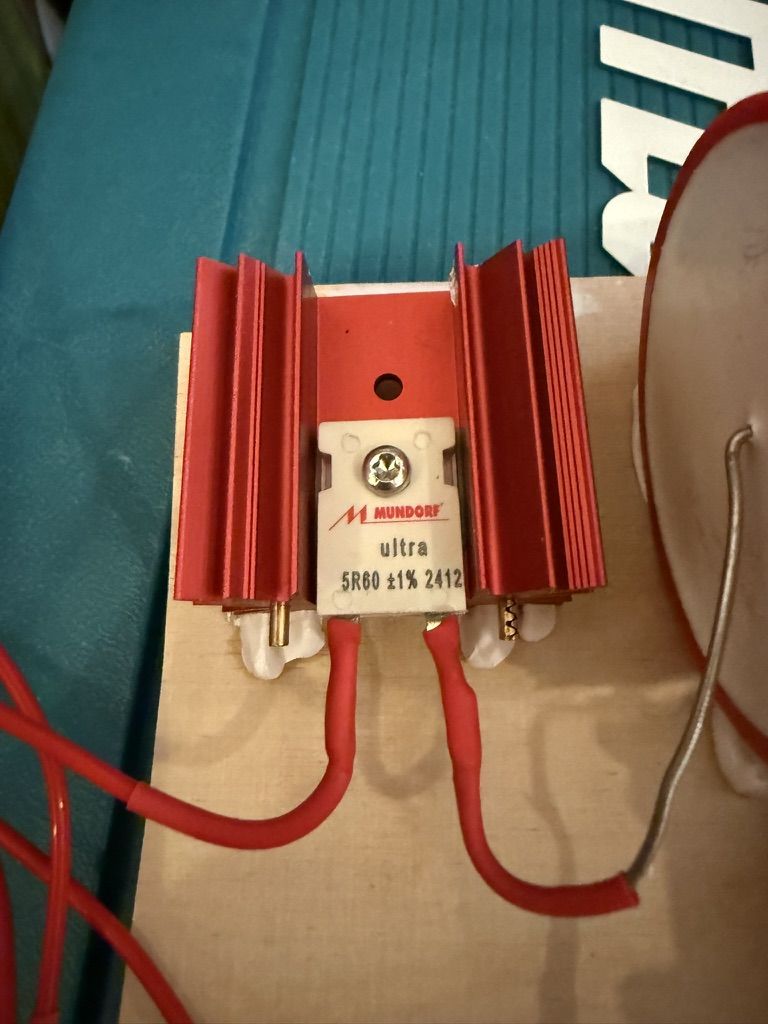
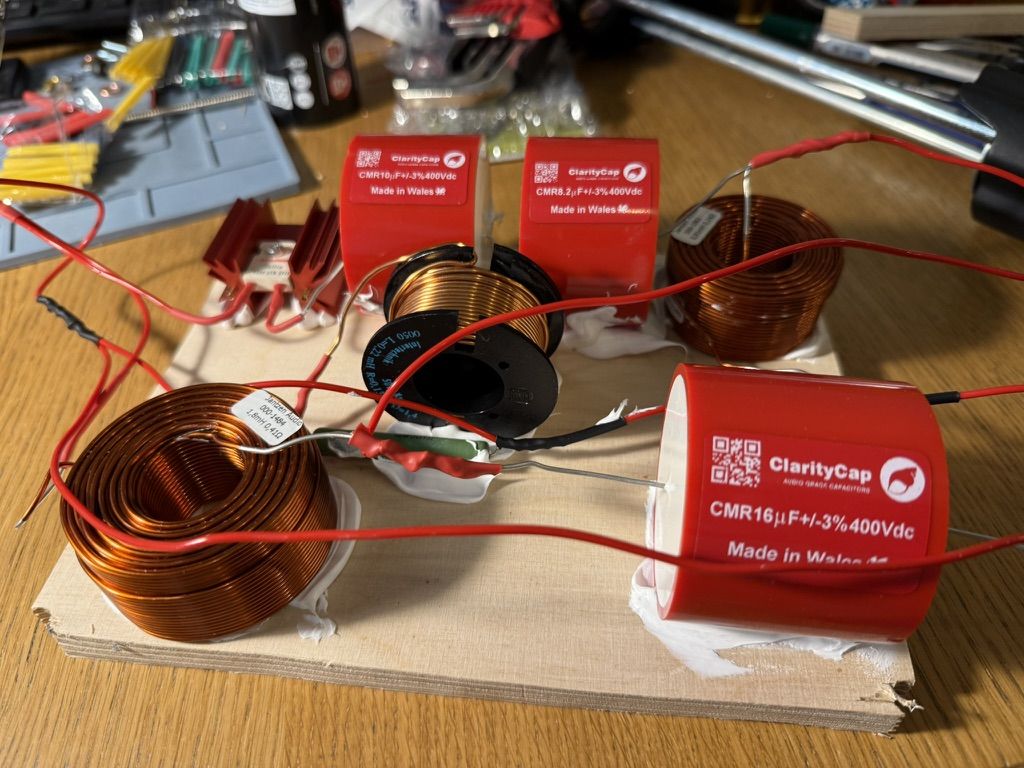
The intent of the parts choice is that the crossover stops being a variable in how the speaker measures and sounds. ClarityCap CMR are audibly transparent capacitors; air-core inductors avoid the small non-linearities ferrite-core parts introduce at higher levels; wirewound resistors don't compress dynamics the way smaller film resistors can on the tweeter leg.
Measurements
Gated on-axis sweep at 1 m, mid–tweeter axis, captured with REW. The chart below is the 1/3-octave gated export on a 10 dB grid — i.e. the room window is closed, so reflections aren't confusing the trace.
Mid & HF — solid line. The midrange and treble sit at roughly 89–91 dB SPL with overall smoothness inside ±1.5 dB across the entire 350 Hz – 20 kHz window. The small dips around 3 kHz and 6 kHz are within ~1 dB of the running mean — baffle-edge diffraction rather than driver issues (revision /R02). The gentle rise from ~14 kHz to 20 kHz is real: characteristic of this tweeter on this baffle, and the source of the speaker's high perceived resolution as well as the slight HF fatigue noted in /R03.
Bass — dotted line. Below ~450 Hz the 1 m gate closes too tightly to be meaningful at this distance, so the bottom is shown as a dotted extrapolation. The curve plateaus at ~90 dB through 100 Hz and rolls off sharply below ~60 Hz, terminating at ~52 dB at 30 Hz — consistent with the slot-port tuning and the 35 L net volume.
Absolute SPL is a calibration assumption rather than a measured certainty — the REW capture wasn't calibrated for absolute level. What matters for the design is the shape: flat ±1.5 dB across the target window, with the small ripples and HF lift discussed below.
What I'd do differently
- /R01 More bracing around the port chamber. The cabinet is cross-braced, but the lower section near the slot port could be tighter — most likely place for any residual cabinet contribution to show up on the next pass.
- /R02 Offset the tweeter to reduce baffle-edge diffraction visible as the ~2–4 kHz ripples. A small horizontal offset on the next baffle revision is the clean fix.
- /R03 Gentle HF tilt-down — the 10–20 kHz lift gives the speaker its high resolution, but it can read a touch fatiguing on long listens. A small L-pad adjustment on the tweeter leg would soften it without losing the top.
- /R04 Add an impedance sweep to the case study so the crossover load is fully characterised.
Status
Completed prototype. In active listening use.
High resolution, with a top-end lift that pays for it in the 10–20 kHz region. Quite happy with what came out — and the improvements on the revision list are the kind of things you only know to do after building the first one.
Three threads continue from this build: