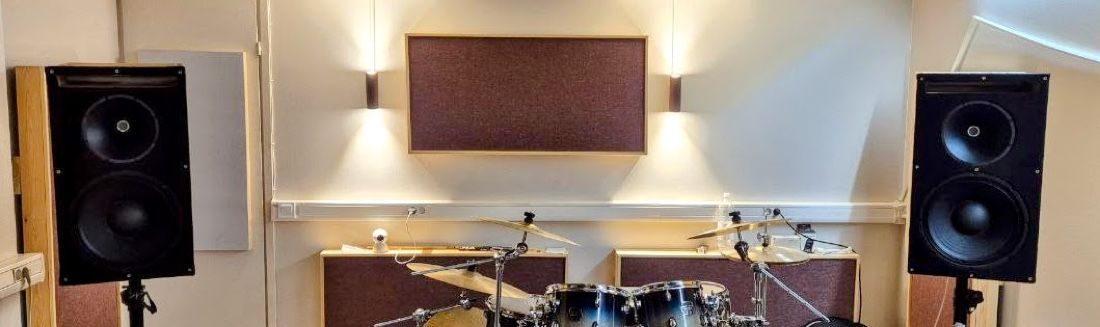
PA-oriented two-way loudspeaker — prototype 1
JBL/Selenium D220Ti and Dayton PA310-8 in a horn-loaded two-way. A high-sensitivity two-way intended for live use — band rehearsal PA monitor / fill rather than hi-fi listening. Sensitivity, pattern control, and reliability under load were the design priorities.
A modest amplifier should drive realistic SPLs; the room shouldn't be the loudest thing in the room; the speaker should hold up under continuous load. Compression-driver / horn-loaded two-way fits all three constraints.
Drivers
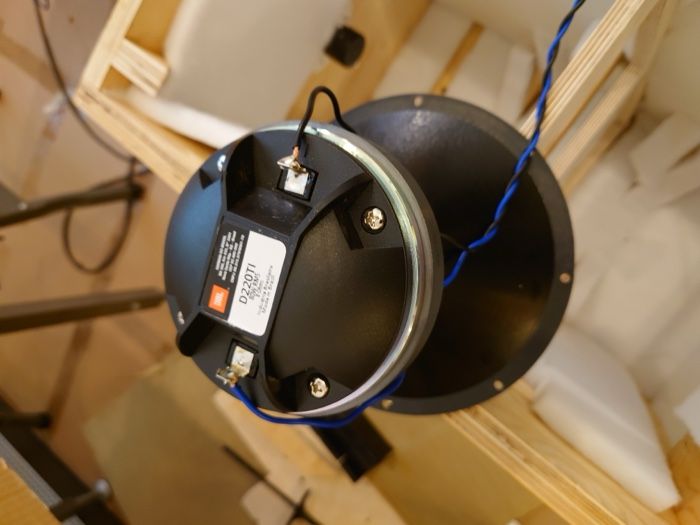
Compression driver — JBL/Selenium D220Ti. 1.4-inch exit, titanium diaphragm, around 108 dB sensitivity — high-output by design, with the standard caveat that compression drivers must be kept above their natural cutoff or they distort and fail quickly.
Waveguide — Dayton Audio H08RW. Round 1-3/8″–18 TPI threaded waveguide matched to the D220.
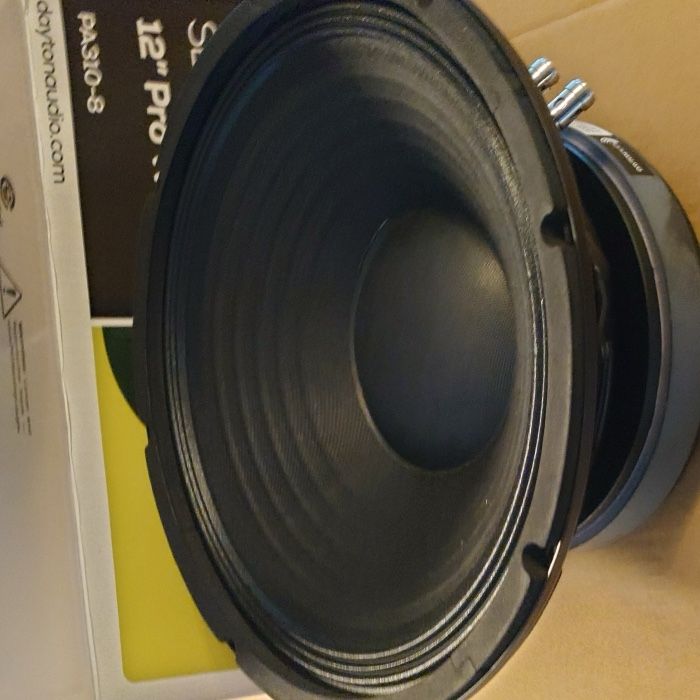
Woofer — Dayton Audio PA310-8. Twelve-inch pro woofer, around 96 dB sensitivity, 8 ohms.
Cabinet
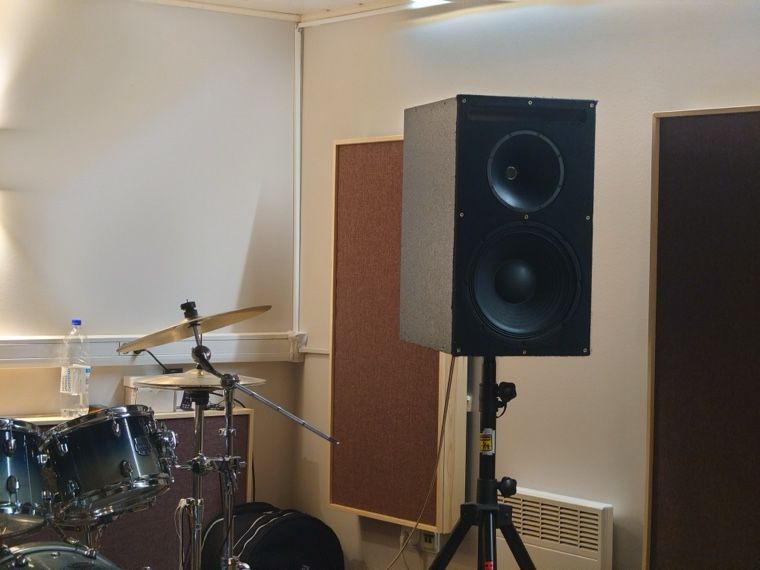
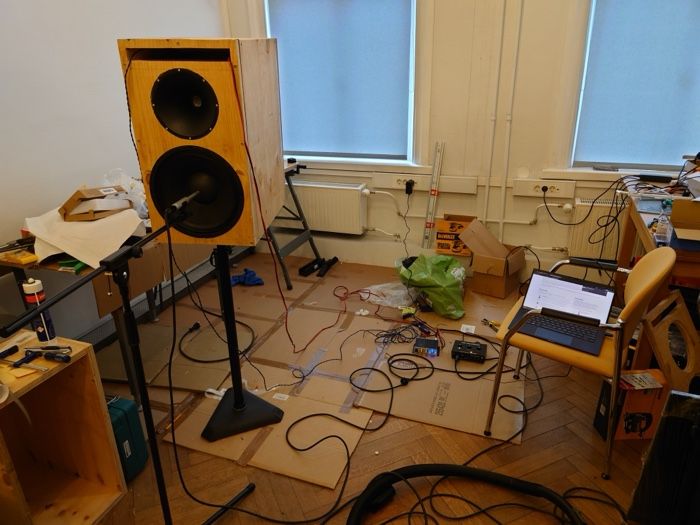
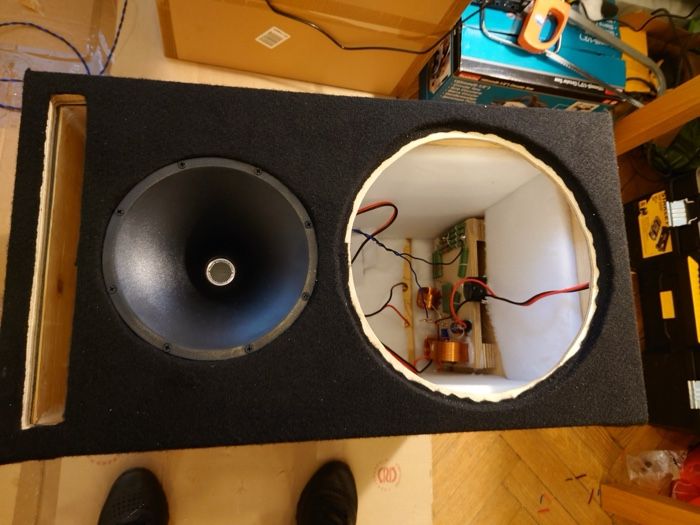
Externally the box is a conventional 12-and-horn front-loaded format on a standard PA stand — plywood carcass with a slot port, finished in DuraTex roller-grade texture coat over a grey baffle.
Crossover
- Topology
- LR4 high-pass on CD; LR2 low-pass on woofer
- Filter rationale
- CD needs a steep electrical filter to stay above mechanical limits
- Attenuation network
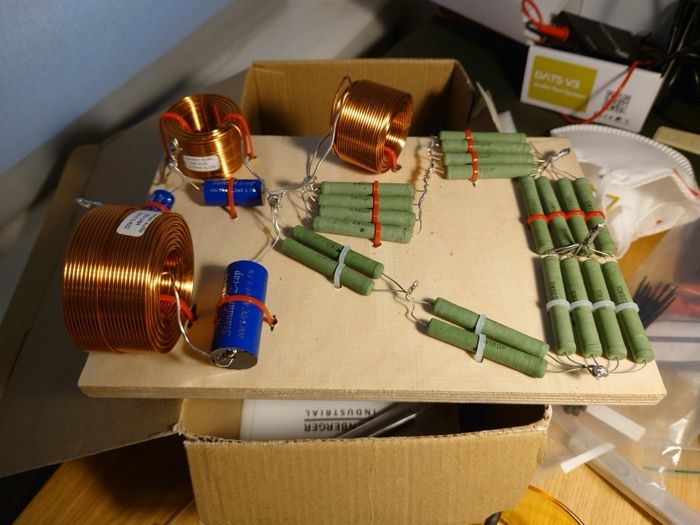
- 12 × 8.2 Ω resistor array (R20–R35), L-pad geometry
- Designed compression
- ~12 dB CD attenuation at 350 W program power
- Thermal strategy
- Dissipation spread across the array — no single resistor is critical
The asymmetric filter order is deliberate. A compression driver needs a steep electrical filter to stay safely above its mechanical limits, while the woofer's natural rolloff combines with the electrical second-order filter to give an effective acoustic slope in the same range.
The compression driver is roughly 12 dB hotter than the woofer, so it needs a sizeable L-pad. Rather than one big resistor, the pad is a parallel array of twelve 8.2 Ω wirewound resistors — spreading dissipation so no single part runs hot at 350 W program power.
Measurements
Gated on-axis sweep, captured with REW. The chart below is the gated mid/HF export on a 5 dB grid — the room window is closed, so reflections aren't confusing the trace. No near-field bass from this session, so the bottom end below 200 Hz isn't shown.
The response sits at roughly 88–91 dB SPL across 200 Hz – 20 kHz, flat to within about ±1.5 dB. The gentle ripples through the midrange and the lift toward 10–15 kHz are characteristic horn behaviour rather than driver faults; the top octave holds up well before a slight rolloff at the very top. Midrange is smoother than the hi-fi tower's, partly because the horn keeps reflections off the cabinet edges and partly because there's only one crossover transition in this band.
Absolute SPL is a calibration assumption rather than a measured certainty — the REW capture wasn't calibrated for absolute level. What matters here is the shape: flat and even across the band.
What I'd do differently
- /R01 Document cabinet dimensions, port tuning, and internal damping formally before the next build — first build, lesson learned.
- /R02 Explore an active DSP-based crossover for the next iteration. Passive networks at PA power levels are expensive in copper and capacitance, and DSP gives much finer control over driver integration and protection.
- /R03 Verify polarity and integration around the crossover frequency with both swept-sine and impulse measurements.
Status
Completed prototype. In active use.
A matched pair now lives in a band rehearsal studio as the monitoring system — the same room treated in the rehearsal-studio case study. They do exactly the job they were designed for: loud, even, and unbothered by continuous use.